

A new lab opened at 17³Ô¹ÏÍøÔÚÏß this summer represents a major leap forward for simulation-based health education in Atlantic Canada, offering students access to more advanced training that will prepare them for complex-care situations.
The Centre for Collaborative Clinical Learning and Research (C3LR)’s existing simulation environments are designed to replicate settings such as hospital wards and primary care clinics.
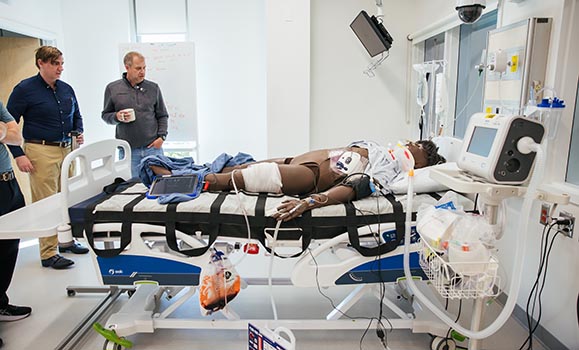
Dal’s new high-fidelity suites, located on the fourth floor of the Collaborative Health Education Building (CHEB) in Halifax, can recreate more unpredictable environments such as intensive-care units, operating rooms, emergency departments, and labour and delivery suites.
Faculty, students, government representatives and supporters gathered at an opening June 17 to celebrate an expansion expected to shape how future healthcare providers learn, collaborate, and deliver care.
“This is an exciting time for our C3LR team as we celebrate the much-needed expansion of our simulation spaces,� says C3LR director, Noel Pendergast.
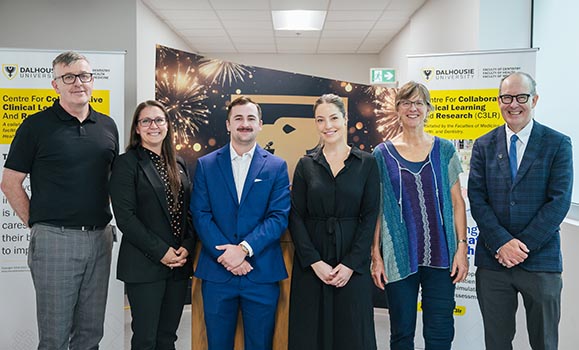
L-R, Noel Pendergast, Julie Vanexan, Riley Spencer, Natasha Clavette-Seguin, Dr. Marion Brown, and former Dean of Medicine, Dr. David Anderson.Â
A space designed for real-world care
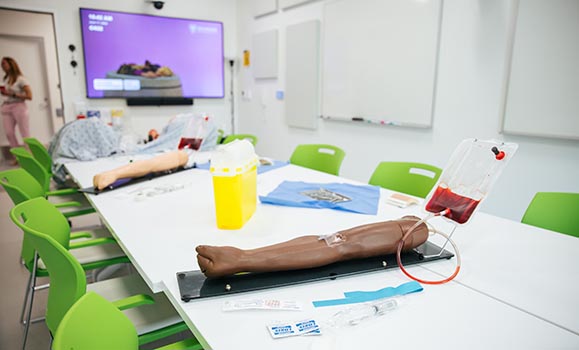
Guests at the opening toured the new space and watched demonstrations of specialized technology in action, including advanced simulation manikins — lifelike training models — capable of breathing, producing heartbeats, and even exhibiting physical responses such as sweating. The space has been designed to mirror real patient interactions as closely as possible.
The new suites include dedicated debriefing rooms adjacent to each simulation space, allowing teams to pause, reflect, and discuss what went well and what they would do differently.Â
“Creating that space for reflection is intentional. Simulation training is designed to normalize learning through mistakes. It gives learners the confidence to ask questions, test their knowledge, and improve their skills without risk to patients,� says Pendergast.
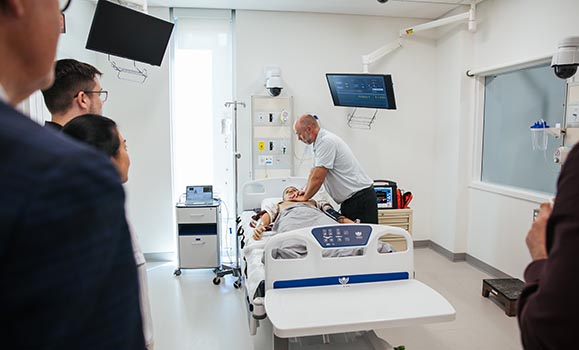
For students and health professionals alike, realism and the opportunity to make mistakes are key. The Centre allows them to practice responding to emergencies and making decisions while learning from mistakes without risk to patients.
Built through collaboration and generosity
A defining feature of the C3LR is its focus on simulation-enhanced interprofessional education, bringing together learners across the Faculties of Medicine and Health to train as teams.Â
Riley Spencer, a student in the and Natasha Clavette-Seguin, a nurse practitioner student, highlighted the shared ownership of the space across programs in their remarks as emcees at the opening.
The event also recognized financial support for the facility from the Province of Nova Scotia and philanthropic partners, including the Windsor Foundation, which has long supported the vision for creating a hub for interprofessional health education at 17³Ô¹ÏÍøÔÚÏß.Â
The province has been a key partner with Dal in strengthening health-care education and workforce development. In 2023, it worked with 17³Ô¹ÏÍøÔÚÏß to launch the Master of Physician Assistant Studies (MPAS) program, the first of its kind in Atlantic Canada, creating a new pathway for training collaborative-care providers while helping address health-care workforce needs across the province.
The province has also worked to meet this need through investments in training programs for physicians, physician assistants, nurse practitioners, and other health professionals. Within 17³Ô¹ÏÍøÔÚÏß's Faculty of Health, enrolment in the Nurse Practitioner program has doubled over the past five years, reflecting the growing importance of team-based primary care in Nova Scotia.
The C3LR reflects the Faculty of Medicine's commitment to preparing learners for the realities of modern health care.
This support, alongside continued investment in infrastructure such as the C3LR simulation space, reflects a shared commitment to building a more responsive, team-based healthcare system in Nova Scotia.
“The C3LR reflects the Faculty of Medicine's commitment to preparing learners for the realities of modern health care,� said Faculty of Medicine Dean David Anderson at the event. “As we expand programs that train physicians, physician assistants, and other health-care professionals, it is equally important that we invest in the tools and learning environments that allow them to develop the skills, confidence, and collaborative mindset needed to deliver exceptional patient care.
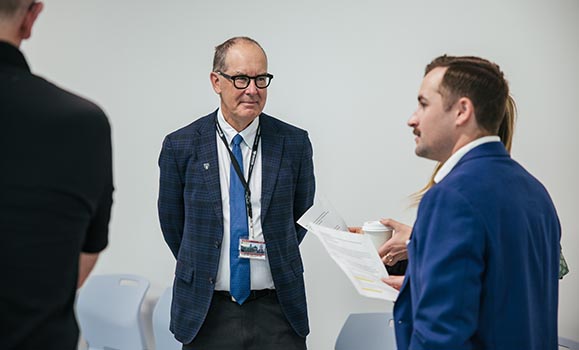
Faculty of Medicine Dean David Anderson, centre.
Pendergast affirmed Dr. Anderson’s words, emphasizing that teamwork is at the heart of both the new space and the care it enables.
“We know that when health-care teams function at a high level, patients, families, and communities do better.â€�Â
A vision still unfolding
While the new space marks a significant milestone, it represents just one phase of a much larger vision for simulation-based education at 17³Ô¹ÏÍøÔÚÏß.
The new suites are part of an initial expansion designed to meet growing demand for hands-on, team-based training. The simulation program is already operating at near full capacity.
The next phase of development will complete the remaining two-thirds of the CHEB’s fourth floor., adding new clinical simulation rooms, practical learning labs, and dedicated spaces for debriefing and skills training.
Realizing that vision will require continued partnership, including support from donors.
Together with government and university investment, philanthropic contributions will play a key role in expanding access to simulation-based learning, ensuring more students and health professionals can train in environments that reflect the complexity of modern care.
For now, the impact is already clear. With its lifelike technology and emphasis on teamwork, the new C3LR simulation space is preparing the next generation of healthcare professionals to meet complex challenges with skill and confidence. Â