
News
» Go to news mainUnderstanding the Water Beneath Our Feet

Growing up in Prince Edward Island (PEI), Dr. Barret Kurylyk had a very unusual feature in his basement: the family well. When something went wrong with the household water supply, he and his father would head downstairs and investigate the issue.
鈥淲e鈥檇 check whether it is the well or the pump or the of general water distribution system in the home,鈥� he recalls, adding that PEI is the only province where everyone relies on groundwater for drinking water, and that groundwater is a part of Islanders鈥� everyday life.聽
Over the years, little has changed. Today, groundwater issues still play a major role in Kurylyk鈥檚 life. Since joining 17吃瓜网在线 Engineering in 2017, he has established himself as a leading researcher in his field. As a professor in the Department of Civil and Resource Engineering and a Canada Research Chair in Coastal Water Resources, his work has a huge impact on communities around the world. His Canadian field sites have included the Canadian Rockies, Sable Island, and the High Arctic.
That work has also earned him numerous honours, including mostly recently, the Geological Society of America鈥檚 2026 50 Under 50 Award and an Engineers Nova Scotia award which he will receive this week.
But despite the importance of his work, Kurylyk says groundwater is easy to overlook.
鈥淚t doesn't get a lot of attention because people can't see it,鈥� he explains. Unlike a lake or river, changes in groundwater levels or quality can go unnoticed because they happen beneath the surface.
鈥淚t's a world where you can't see the resource, where people aren't as emotionally invested as they are in surface water,鈥� he continues. 鈥淏ut it's a world that society very much depends on.鈥�
In Canada alone, about one-third of the population relies on groundwater for drinking water. In Nova Scotia, that figure rises to almost 50 per cent, with rural households often depending on private wells rather than municipal water systems.
Protecting Coastal Water
Protecting these supplies is a major focus of Kurylyk鈥檚 research, especially in coastal communities where erosion, flooding and rising sea levels can threaten groundwater quality.
鈥淐oastal population density is about three times as high as population density inland,鈥� he says. 鈥淪o there鈥檚 a lot more people along the coast and they have a lot of water demands and, in many places globally, coastal water resources are being salinized by over-extraction or sea-level rise. So we鈥檙e looking at alternative water supplies.鈥�
In the Gulf of St. Lawrence, north of PEI, a 17吃瓜网在线 team聽including Kurylyk鈥檚 lab is studying whether freshwater beneath the ocean floor could provide another source of water for coastal communities. The freshwater accumulated underground thousands of years ago, when sea levels were lower and areas now covered by the ocean were still dry land.
At the same time, Kurylyk鈥檚 team is studying threats to existing groundwater supplies. At Rainbow Haven and Martinique beaches in Nova Scotia, researchers are investigating saltwater intrusion, which occurs when seawater enters freshwater aquifers. Coastal erosion, flooding, rising sea levels and groundwater pumping can all contribute to the problem, threatening nearby water supplies. His lab also recently published work on the impacts of the historic 2025 Nova Scotia drought on groundwater-dependent communities.
The team is also examining whether saltwater can cause naturally occurring arsenic in rock to enter groundwater, potentially making it unsafe to drink.
Learning in the Field
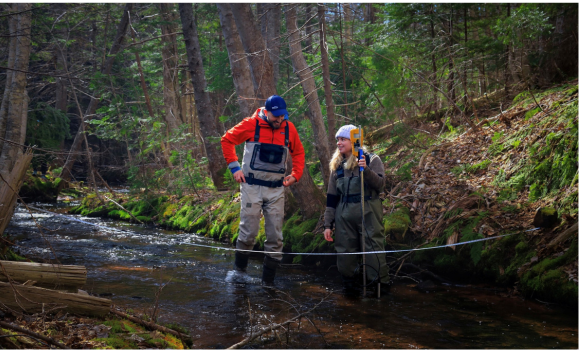 Photo credit:聽Ryan Malley
Kurylyk leads Dal鈥檚 Coastal Hydrology Lab within the Centre for Water Resources Studies. His team includes graduate students, postdoctoral researchers and undergraduate engineering students who contribute to fieldwork and computational research. For many of the undergraduates, Kurylyk鈥檚 fourth-year Engineering Hydrogeology course is their first chance to learn about groundwater issues.
鈥淪tudents learn about the geological systems through which groundwater flows. They learn about the equations that describe groundwater flow and contaminant transport and form our mathematical representation of the physics of groundwater flow, 鈥渆xplains Kurylyk. 鈥淭hey learn about practical tests that you can do in aquifers to figure out their properties. Because you can't see an aquifer, it gets tricky to conceptualise them or even to measure or assign them properties.鈥�
Students also get the opportunity to venture into the field. Using a network of observation wells on Dal鈥檚 Sexton Campus, they measure groundwater levels, collect samples and study how aquifers respond to pumping. While the experience helps students see how groundwater research can benefit the environment and the communities who depend on it, for Kurylyk, the impact of this work wouldn鈥檛 be possible without the students who help make it happen.
鈥淚t鈥檚 very much a team sport,鈥� he says. 鈥淭he work I lead out of my lab is not just me. It鈥檚 a whole team of students and postdoctoral fellows, as well as colleagues around the world that we engage with. So it鈥檚 nice to have the teamwork recognised. I think it鈥檚 important work, and it鈥檚 appreciated when people understand the value of groundwater research and education.鈥�
Recent News
- Understanding the Water Beneath Our Feet
- A Shift in Energy
- Dal Engineering grad builds a better way to find a roommate
- Faculty of Engineering鈥檚 new Indigenous Pathways Program Coordinator Pays It Forward
- How Two PhD Students Are Powering Nova Scotia鈥檚 Tidal Future
- How the Faculty of Engineering鈥檚 Annual Golf Tournament Helps Bring Student Ideas to Life
- Meet the Team behind the Jumpsuits: How the 17吃瓜网在线 Engineering Gearheads are making an impact
- Celebrating 90 years of Dr. Dhandapani Thirumurthi