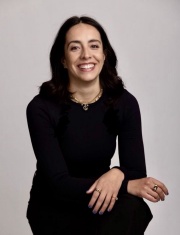
Paola Veneras
MDE (2012), PhD (2021)
For most of my undergraduate degree, I was convinced I would pursue an MBA. I moved to Canada thinking that Economics and Business would be the ideal degree combination for eventually founding a company that would help solve the socioeconomic problems burdening Ecuador. Growing up in Quito, I had a hard time reconciling my own life with the vastly different realities that surrounded me. I went to school, played sports, and had a loving family, while at many stoplights, children my age begged for food and money. I could not understand how, so arbitrarily, the lottery of birth had set us on such different paths when, in all ways that mattered, we were equals.
Nearing graduation at St. Thomas University, I knew I wanted to focus on poverty alleviation in Latin America. While I was preparing graduate school applications, one of my professors at STU, Dr. Barry Watson, who was completing his PhD at 17吃瓜网在线 at the time, suggested I look at Dal鈥檚 Master in Development Economics program. Knowing my background and interests, he pointed out how well the program matched what I wanted to do, and he was right. I applied, was admitted and moved to Halifax, quite excited about the prospect of a milder climate and living by the ocean. Choosing 17吃瓜网在线 put me on a very different career path from the one I had imagined and spared the world one more twentysomething 鈥渄isruptor鈥� trying to fix poverty with a new venture.
During both my master鈥檚 and PhD, I was welcomed into friendly, diverse, and supportive cohorts that held themselves to remarkably high academic standards. I was fascinated and at times intimidated by how driven everyone was. We engaged deeply in lectures, studied at the library for hours (sometimes staying so late that we got locked in), filled whiteboards with 鈥渢he outlines of the summaries of the 鈥榞ood鈥� notes of the class notes,鈥� attended seminars and enjoyed very fun social events. Looking back, I am really grateful that working hard and being supportive of one another was the norm at 17吃瓜网在线. Our professors were central to this, as the standards we held ourselves to were only possible because their high expectations came with the same effort put towards helping us succeed.
After finishing the MDE, I had a hard time deciding what to do next. I had already been admitted to the PhD program at 17吃瓜网在线, but before starting my undergraduate degree and moving to Canada, I had promised my mom that I would eventually return to Ecuador. As somewhat of a compromise, I deferred my acceptance for a year and returned to Quito for work.
A political consulting firm, Politik S.A., hired me and I was pleasantly surprised by how much of what I learned I could immediately put to use. As an analyst, I was initially tasked with researching the socioeconomic conditions characterizing Ecuador鈥檚 most pressing needs for a client, a political party that was running in the next presidential election. Dr. Talan 陌艧can鈥檚 country-focused term paper for Macroeconomics, which took a full semester and various rounds of revisions on drafts that were often extensively covered in red ink, turned out to be remarkably useful in helping me get this done. I was then asked to brainstorm policies that would address the issues we had identified. The development courses taught by Dr. Daniel Rosenblum, Dr. Mevlude Akbulut-Yuksel and Dr. Barry Lesser, the health economics course taught by Dr. Courtney Ward, and the many hours spent reading journal articles and paying close attention in lectures gave me a wealth of examples of policy interventions, research instruments and empirical evidence to draw from. For most of this work, I was also using Ecuador鈥檚 publicly available datasets. Applied Econometrics taught by Dr. Casey Warman came in very handy whenever I had to summarize and present these data to my colleagues. At the time, I was also using the old, black-background, green-letters version of Stata, and even though I was mostly just tabulating data, I think that the Matrix-adjacent look helped me appear capable and earned me some brownie points in the office.
Another surprise from Politik S.A. was how much I enjoyed working in consulting. Our diverse team of analysts (a lawyer, a political scientist, two communication strategists and me, the economist) was (in my opinion) the company鈥檚 biggest strength because we complemented each other so well. It also made work incredibly fun, and my coworkers remain some of my favourite people and closest friends. The biggest highlight of my time working in Ecuador will always be the people I worked with, but a close second was being offered to establish Ecuador鈥檚 first socioeconomic think tank, Numma S.A., Politik鈥檚 sister company. We launched Numma S.A., and began conducting nationally representative surveys on wellbeing, political ideology and participation, and designed socioeconomic indicators to track Ecuador鈥檚 development. We built a client portfolio that included both the public and private sectors, and I am proud to say that although I am no longer affiliated with Numma, it is in great hands and remains an active and successful company in Ecuador.
As a fun fact I may or may not still bring up at parties, during a mayoral race in Quito, Numma was the only organization to correctly forecast the winner. I believe that this is a direct product of what I learned at 17吃瓜网在线. Learning to be careful and precise about notation in Dr. Ward鈥檚 and Dr. 陌艧can鈥檚 classes and the intuitive understanding of econometrics I developed in Dr. Yulia Kotlyarova鈥檚 courses shaped the methodology behind every survey we designed and every project we completed. I believe it is why our forecast was the only one that turned out to be right.
In 2014, I returned to 17吃瓜网在线 for my PhD. For a couple of years, I went back to Ecuador and worked during my summer breaks, but once I completed my courses and it came time to write my comprehensive exams, I stepped away from consulting entirely. While I had a wonderful time during my master鈥檚, my favourite time at 17吃瓜网在线 was completing the coursework requirements during my PhD. Taking advanced courses in Macroeconomics, Econometrics, and Microeconomics while also enrolling in and auditing as many electives as I could was so impactful that my career path started shifting again. Initially, when I started my PhD my main (and very naive) goal was to learn everything there was to learn about Economics so that I could return to work in development and poverty alleviation. (Spoiler: I quickly came to understand the opposite, since the more I learned, the more I discovered how little I actually knew). Being one student in a class of at most five, learning the most advanced and hardest topics in economics, left me in awe every single day and fundamentally changed me. All I wanted to do for the rest of my life was to keep learning, studying and absorbing every concept and theory I was introduced to. Once I started teaching, I became certain that I wanted to be a professor and to do as good a job as my professors did, so that students could fall in love with our field and our theories and models, and see their applications just as I did. After graduating, I was hired at the University of Victoria where I now work as an Assistant Teaching Professor.
Everything that I am as a professor was molded by and learned from our faculty at 17吃瓜网在线. From the mechanics of giving good presentations, developing appropriate tables and graphs, to the importance of integrity, to organizing code and files so others can follow them, to simply being a kind, supportive person, I have written pages and pages about how much our professors shaped me. What follows is the very abridged and non-exhaustive list of my favourite and most impactful lessons (my teaching dossier is available upon request).
路 One of the first classes I had at 17吃瓜网在线 was a research seminar led by Dr. Lars Osberg. Every week, we presented papers and our own research ideas. I was later lucky to have Dr. Osberg on both my thesis and dissertation committees. To this day, whenever I give or watch a presentation, or look at a graph on a paper, I know that many of us alumni ask ourselves: WWLOD, 鈥渨hat would Lars Osberg do?鈥� Is the presentation clear? Are the charts, axes and tables properly labeled? Are the axes鈥� lengths consistent? Might any graph appear misleading? If I were to randomly open this paper and look at the table or graph, could I understand what is happening?
路 Although my field of expertise and research is applied microeconomics, I have taught macroeconomics for most of my academic career. In large part this is because of how many macroeconomics courses I took at 17吃瓜网在线. During the MDE, I took Dr. 陌艧can鈥檚 macroeconomics class. During my PhD, Dr. Andrea Giusto was re-designing the MA macroeconomics class and I took three iterations of it because of how much I enjoyed the first class I took. I also took the PhD advanced macroeconomics class with Dr. 陌艧can and two applied macroeconomics classes with Dr. Giusto (one theoretical, one computational). I often think of how much I wish I could bottle the feeling of wonder and awe our entire class felt when Dr. 陌艧can showed us the elegant analytical solution to a lifetime utility problem where we obtained a clean decomposition of optimal consumption allocations into consumption smoothing, intertemporal substitution and precautionary savings motives; or when during office hours with Dr. Giusto, I finally understood the 11-page-long proof of the properties and conditions under which solutions to the sequence problem and the functional equation are the same in a Ramsey model (I did go back to my notes to check that what I am writing makes sense, so any errors are my own, the 2016 student version). I will always be grateful for how encouraged I felt to keep learning, and keep trying to understand the material, independent of how hard it felt.
路 I am thankful to Dr. Mutlu Yuksel, Dr. Mev Akbulut-Yuksel and Dr. Casey Warman for fostering my curiosity in my field and inspiring me to become a lifelong learner.
路 Every professor I asked for help was immensely patient and kind. I am deeply grateful for all the encouragement, mentoring and nurturing shown to me by Dr. Shelley Phipps and Dr. Peter Burton (especially during my comprehensive exams, while finishing my thesis and on the job market). I think of them often when I pay it forward.
路 If you asked any of my students, especially those in Statistics and Probability at UVic, how many times I go back to precise notation and ask them to explain every concept to a five-year-old with no knowledge of economics, they would probably tell you that 鈥渢he limit does not exist.鈥� It is thanks to Dr. Ward and Dr. Kotlyarova that I developed an appreciation for precision and deep intuitive understanding.
路 I am now often in a supervisory role for many teaching assistants. I try to guide them with the same kindness and clarity that Dr. Christos Ntantamis and Dr. 陌艧can showed me. I also learned to be consistent, a team player and innovative in designing helpful tutorials after many years of working for Dr. Catherine Boulatoff and Dr. Tess Cyrus. I also keep tradition by ordering pizza whenever there is a grading marathon for my large classes.
Lastly, and importantly, my time in the department taught me how much we rely on our staff. Monique, Heather and Jodi were there at every turn, keeping the machine running and helping untangle every administrative pickle I managed to get myself into.
I feel very grateful to have been trained at 17吃瓜网在线. After many years in academia, I know how rare it is to have 鈥済rown up鈥� in such a nurturing place. While I may not have solved poverty, much of my research is still devoted to understanding it and helping address inequality. My entire career trajectory changed because of one comment made at the right time. I don鈥檛 know if I鈥檒l ever be able to offer my students a path as lucky as the one I was given, but in every class that I teach, I try to help them enjoy economics as much as I did when I was a student at 17吃瓜网在线.
As a thank you for his kindness, love and for being my biggest cheerleader throughout my PhD, we鈥檝e started a bursary in memory of Mark Higgins. The award will be granted to PhD students following their fourth year, to assist with expenses associated with completing their degree and research. If you鈥檇 like to donate, please go to http://giving.dal.ca/markhiggins