
Nuclear Medicine Technology
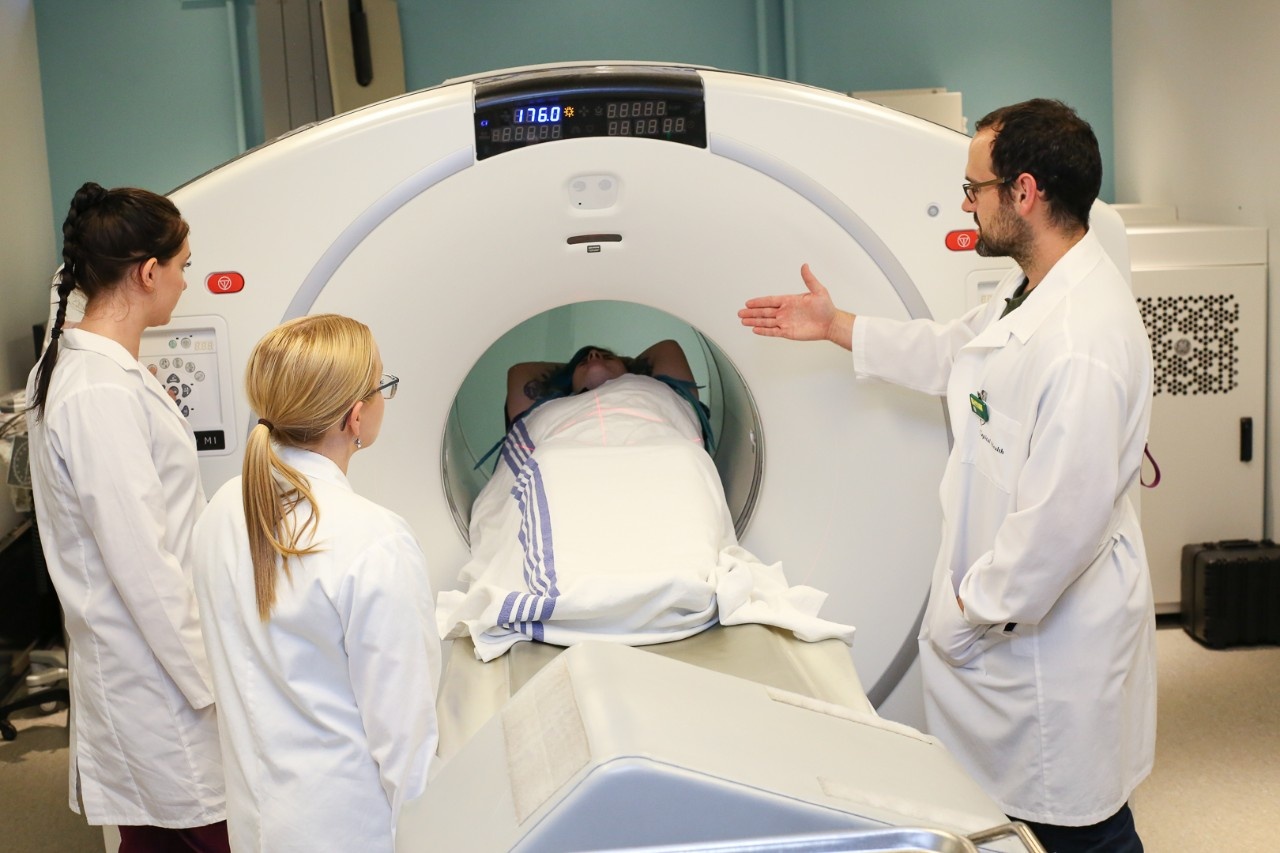
Nuclear Medicine Technologists are highly skilled health care professionals who use radioactive tracers called radiopharmaceuticals to help diagnose and treat a variety of illnesses. They see patients of all age groups, from newborns to older adults.
Nuclear Medicine Technologists may also be known as Medical Radiation Technologists (MRTs).
How do I become a Nuclear Medicine Technologist?
To become a Nuclear Medicine Technologist, individuals must attend and successfully complete an accredited Nuclear Medicine Technology program.
The School of Health Sciences offers a four year Bachelor of Health Sciences (BHSc) degree program, which includes theory and practice.聽
Graduates must write national registration exams and meet the clinical requirements set by the Canadian Association of Medical Radiation Technologists (CAMRT) in order to work. Those who pass the exam may use the designation "Registered Technologist in Nuclear Medicine" (RTNM).
17吃瓜网在线's Nuclear Medicine Technology program curriculum offers the necessary competencies to challenge the Canadian Association of Medical Radiation Technologists (CAMRT) professional examination.
Entrance Requirements
To be considered for admission, High School applicants require grade 12 academic English, Math, Physics and Chemistry with no mark below 70% in each of these courses and an overall minimum average of 75%. Post-secondary applicants require a minimum GPA of 2.75 (on a 4.30 scale), with no grade lower than C in prerequisite courses.聽
Applicants are also required to submit non-academic documents to be considered for admission.
The Nuclear Medicine Technology program accepts 8 total students annually.
1 seat in the Nuclear Medicine Technology program is reserved for residents from each of PEI, New Brunswick, and Newfoundland. Priority for all other seats will be given to qualified Nova Scotia residents.聽 If seats remain, residents of other maritime provinces followed by residents across Canada will be considered.
Due to residency restrictions and limited capacity, international applicants will not be considered for admission to the BHSc program.
Admission is competitive, and meeting the minimum entrance requirements does not guarantee admission.
For further details on the application process and other considerations, please review our Admissions wepbage.
Clinical Education
For full details on Clinical Education, including preclinical requirements, please review our Clinical Education webpage.
One of the benefits of studying at the School of Health Sciences is the opportunity to do hands-on clinical work. In years 1, 2, and 3, every student spends 6-8 weeks during the summer term completing a clinical practicum in a healthcare setting. In addition, third year students complete multiple clinical education courses directly in the clinical environment to help prepare them for entry to practice. During the clinical practicum, students may be required to work evenings, nights and weekends.
Most students complete their practicums throughout Atlantic Canada, while others travel to locations across the country. Students should be prepared to travel outside of Halifax or their home communities for their clinical placements. Placement opportunities are based on clinical site availability and are subject to change from year to year. Health Sciences students are provided with more information about availability and options before each clinical experience.
Ready to apply?
Please review our Admissions webpage, which includes information on the application process, non-academic requirements, and other considerations, such as additional costs and residency eligibility.